About Agadir
A short, factual guide to the city — its history, its beach and kasbah, the climate, and how to get there.
A city that started again
On the night of 29 February 1960, a shallow earthquake of magnitude 5.8 destroyed most of Agadir. Between 12,000 and 15,000 people died — roughly a third of the population at the time. The city was rebuilt on a new plan with stricter building rules, which is why today's Agadir feels spacious and modern compared with older Moroccan cities.
Agadir Oufella, the kasbah on the hill
The fortress on the hill north of the centre dates back to the Saadian era of the 16th century and stands about 236 m above sea level. It was ruined in 1960 and its walls have been restored in recent years. Since July 2022, a cable car has linked the lower city to the hilltop, where the views over the bay are superb.
The beach and seafront
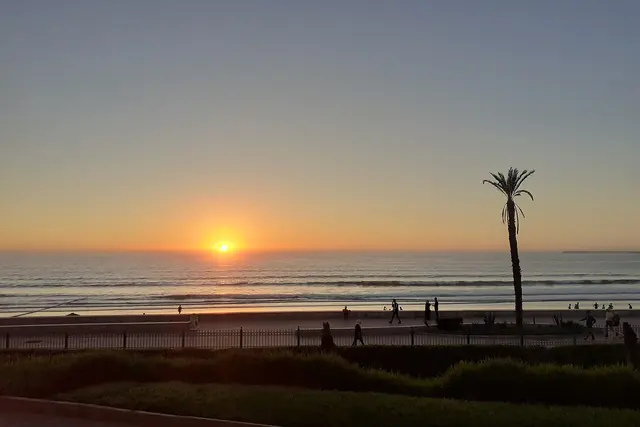
Agadir's crescent of sand curves south from the marina and port, backed by a long promenade lined with cafés and hotels. It is a sheltered city beach, popular for walking, swimming in calmer conditions and watching the sunset.
Souk El Had
The city's great market sits inland behind high walls with monumental gates. It is used by residents for everyday shopping and is often described as having some 6,000 stalls. See our Souk El Had page for tips.
Climate
Agadir has a mild, dry climate cooled by the Atlantic. Daytime highs are typically around 20°C in winter and in the high 20s in summer, and most of the year's modest rainfall comes between late autumn and early spring. Inland, the hills can be noticeably hotter in summer and cooler on winter nights.
Getting there
Agadir Al Massira airport lies about 25 km south-east of the city. By road, Marrakech is about 250 km away — roughly three hours each way by motorway. Within the city, petit taxis are the usual way to get around.
Where our experiences take you
Agadir Oufella & the seafront
The hilltop kasbah, cable car, marina and promenade — the heart of the city.
Souk El Had
The city's walled market, with thousands of stalls for food, spices and crafts.
Taghazout
A fishing village turned surf hub, about 19 km up the coast.
Paradise Valley
Rock pools and palms in a foothill gorge, about an hour inland.
Imouzzer Ida Outanane
Honey, seasonal waterfalls and Amazigh villages around 60 km north-east.
Drarga & Crocoparc
Crocodiles and botanical gardens on the eastern edge of Agadir.
Souss river mouth
Countryside and estuary on the city's southern edge — lovely at sunset.
Souss-Massa National Park
Protected coast, dunes and rare birds south of the city.
Planning your days in Agadir?
Send us your dates and interests and we'll suggest which experiences fit — honestly and by email.